


Brent Bryksa: Cannabis, Accessibility and Purpose
The founder of The Wheelchair Weed Cannabis Company reflects on medical cannabis, building an accessible grow operation and creating opportunity through lived experience - By Brent Bryksa

Personal Journey
Well my background was similar to a lot of teenagers in high school where I would enjoy smoking weed with my friends pretty much at any opportunity whether it was at lunchtime during the school day or after school and on weekends. I often smoked by myself and would listen to my music in my bedroom and try and figure out what I am going to do with my life when I get out of high school.
Then on May 9, 1998, I was involved in a single-vehicle car accident as a result of drinking and driving and due to this I ended up on life support and paralyzed from the chest down for life. It was at this point where I began to see cannabis as a medicine and a way to treat my many health conditions with a natural painkiller and a safer way to reduce my muscle spasms that would keep me up all night every night.
The doctor that was assigned to me in Parkwood Hospital in London, Ontario was very honest with me and told me the truth that the many toxic medications I was on for pain and for muscle spasticity are far worse for my health than using cannabis to try and treat myself. At the time, there was no such thing as a medical license for cannabis and home growing licenses were not yet possible. It was then that I started researching what is called a section 56 exemption. This exemption allowed me to use cannabis and grow my own plants for my medical purposes with the approval of my doctor and after trying many different medications for my health condition that either didn't work or the side effects were too harmful to continue using long-term.
After growing for myself and using cannabis to help with the withdrawal symptoms of getting myself off all the painkillers and muscle spasticity medications I began to get my life together and for once I could start thinking clearly and dreaming about my future. I moved to B.C. in 2004 to start a new life and try and forget all the horrible things I had experienced in the hospital and to live a healthier way of life that did not seem possible if I didn't move away.
I began to get approached by other medical patients with severe health conditions that use cannabis but had no safe way of getting their supply and were unable to grow their own plants so I began to grow for other patients as a designated grower. As time went by, more and more patients reached out to me for my help and I began to provide my medicine and consulting to medical dispensaries in Vancouver. This opportunity to help many patients who are struggling with health issues just like I am gave me a purpose and allowed me to focus on my goal of being a legitimate medicine farmer who helps people in need of medical-grade cannabis to live a healthier way of life and cope with their serious health conditions.
Fast-forward about 15 years and with cannabis becoming legalized and more acceptable in mainstream society I began exploring the opportunity to open my own business and be able to provide my medicine to medical patients and cannabis users across the country. When the micro-licenses were announced by Health Canada this seemed like the right opportunity for me to enter the regulated industry.
After living with a spinal cord injury for decades and through some of the most difficult experiences imaginable, I thought I would be capable of handling anything that came up during the difficult licensing process with Health Canada to start my own business and the regulated cannabis industry. I had no idea how little support there is for growers like myself entering the regulated cannabis industry and I was left to figure it out on my own and had to hire consultants to help me with the ridiculous amount of paperwork involved in getting a license. Like many others in the industry, I did not receive the level of consulting support I expected or paid for, which added further stress to an already difficult process.
To this day, I'm still advocating for more support programs and more assistance for growers transitioning to the regulated cannabis industry as there is currently a lack of help available which puts growers at the mercy of unregulated consulting companies leaving applicants like me dependent on private consulting companies when trying to enter the cannabis industry but need help understanding and filling out the enormous amount of paperwork to become licensed and begin operating.
Building the Business
The inspiration behind starting The Wheelchair Weed Cannabis Company came from spending thousands of hours by myself in my grow rooms taking care of my plants and thinking what the future could be like if I was able to live long enough to see it. Cannabis was not accepted in society when I started growing and for many years afterwards and I had to keep what I was doing very quiet as to not bring shame to my family or bring unwanted attention to what I was doing.
I always thought that if I can just hang on long enough and keep working hard each day that there would come a time where I would be able to tell my story and help many people across the country who are struggling with issues that I deal with every single day. To know that there are people that rely on me to grow their medicine to help them get through the day has given me purpose to continue fighting through each day and getting out of bed to go take care of my plants when my body is telling me to just lay in bed and rest. Helping people who are struggling has always been a lifelong goal of mine but my issues with social anxiety, depression, PTSD, ulcerative colitis and many other health issues has made it difficult to speak to people over the years but I'm now at a place in my life where I'm able to tell my story without breaking down into tears each time I tell it.
Some of the biggest challenges of running a business in the regulated cannabis industry is the lack of funding, lack of licensing support, and lack of clarity around the rules which are open to interpretation. I have yet to qualify for any funding support but I continue to send in applications and call various levels of government requesting people to advocate for the farmers who grow the medicine to supply patients across Canada yet are not considered part of the overall farming community and do not get the same support and access to funding programs that other farmers are able to access. The financial stress combined with learning all the rules and regulations of an heavily regulated industry has affected my health significantly and I hope in the future that applicants don't have to go through the same process that I've gone through.
Some of the things I'm most proud of at this point even though it's very early stages of running my business is that I'm able to raise awareness for people with disabilities in the cannabis industry whether they are employed in the cannabis industry or are patients who use cannabis to help them get through each day. Many of us who have conditions that are incurable just want some relief from the pain and the sickness associated with our conditions and do not want to be taking pharmaceutical medications that only add to the list of health problems we are already dealing with. I can't tell you how many patients I've spoken to in hospital waiting rooms or through emails that have reached out to me asking for information about which types of cannabis could help them with their health problems and how to safely access it. My goal has always been to be able to provide my medical-grade cannabis directly to patients across the country but the current rules around setting up a medical sales platform are very complicated and almost unattainable for someone like me even though I've already paid for the medical sales license and have gone through the strict licensing process.
I'm also very proud that my family and friends no longer have to worry about telling their friends what I do for a living and do not have to carry that stress with them any longer. I've never felt that I was doing anything wrong all these years but in the eyes of some people they did not agree with cannabis being used as a medicine and it's only recently that the stigma around cannabis use has changed and people are more open to natural medicines after seeing how devastating the opiate crisis has been in Canada and around the world. Had I not been granted my section 56 license after my car accident to help with my serious health issues I have no doubt that I would be one of the many medical patients that were overprescribed opiates and as a result their lives fell apart. I'm eternally grateful to the doctors who were open to discussing cannabis use with me almost 30 years ago and to my family who accepted my choice that I no longer wanted to take prescription medications and wanted to treat myself with my own plants in my own medicine.
Ever since Wheelchair Weed was launched many things have changed from the way I expected things to go. The consultants that I had hired were supposed to take care of all sales and help set up my medical sales platform to allow me to provide my medicine to patients across the country. Due to the consultants not fulfilling their obligations I had to transition from being a farmer to becoming a farmer, salesperson, marketing specialist and website designer, which added a huge amount of stress and additional responsibility that was not initially part of the business plan. I'm very lucky to have survived the first year of operating my business and I now have a better understanding of just how difficult and stressful running a business in the cannabis industry can be while navigating limited support and guidance from government agencies. I've been working on telling my experience to Health Canada and the Ministry of Agriculture to help make changes to the policies that are currently in place that make transitioning to the regulated cannabis industry such a stressful and complicated process for a small business owner.
The Grow Operation
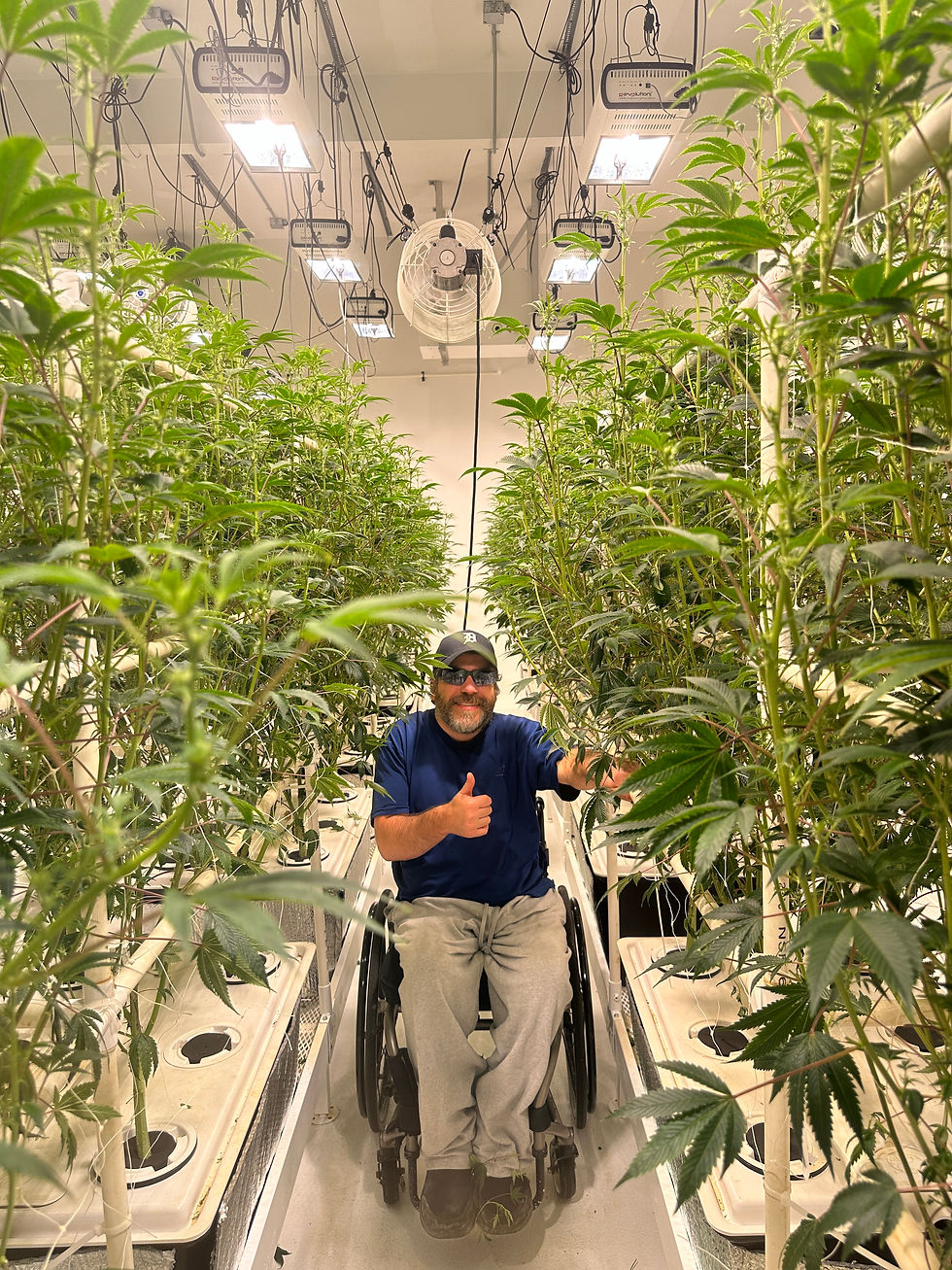
When I built my first grow room back in 1999 the focus back then and up until now has always been about accessibility and independence. I designed my grow rooms with the intention that I will be doing all the work myself and that means everything needs to be accessible from a wheelchair and that there can't be any obstructions on the floor that would prevent me from doing my work. I've always preferred to work alone as it allows me to focus on the plants and it allows me to reflect about my life and how grateful I am to be able to grow my own plants and help others.
Currently, I'm growing in deep water culture hydroponic systems that eliminate the need to bring the soil into my facility which was always one of the hardest aspects of my job. Now I'm able to open valves to let water in to my grow rooms to feed the plants and open valves to flush the water with the help of heavy-duty water pumps and this allows me to operate independently and without risking injury to transplant or to feed all the plants in my facility. I grew in soil for many years and enjoyed it very much and grew very good medicine so there's many ways to grow high-quality cannabis and it's all about finding the best system and the best setup for each individual and designing it around their abilities.
In my facility I make sure that there are no obstructions that would prevent wheelchair access or someone with visual impairment to be able to get around my facility safely. All grow rooms have always wide enough for a wheelchair and the plants are at a height that can be worked on from a seated or standing position. I'm currently working on getting mobile benches into each of my grow rooms to allow for greater production capacity without sacrificing accessibility and independence.
Currently, a typical day for me involves starting at 8 AM to check on the plants and make sure nothing happened overnight that needs to be addressed immediately. After that I am making a list of all necessary tasks that need to be completed throughout the day along with any observations that I noticed during my morning rounds. The rest of the day is spent in sales meetings and licensing meetings trying to explore ways to get the medicine that I'm growing into the hands of the patients that need it as well as working on grant and funding submissions to different programs to try and get help scaling up my business. In between all the meetings I am in the facility with the plants doing whatever needs to get done and making sure that everything stays on schedule. Through it all, cannabis, accessability and purpose remain at the heart of my work - guiding how I grow my business and serve the patients who depend on it.
I think one thing that people are surprised to learn about running a business in the regulated cannabis industry is that just because you have a business and a brand it does not mean that you're making lots of money. Most companies are just barely surviving due to the overtaxation on cannabis products in Canada and this is forcing companies to export their product to countries that have a better system in place to support cannabis producers. The cannabis industry in Canada should be leading the way in how to support a healthy legalized cannabis industry but the policies in place on a federal and provincial level mean that the tax and regulatory burden can leave hard-working farmers struggling to survive. There needs to be a lot of changes in Canada if the industry is going to survive and grow, but for now we are taking a backseat to countries like Australia, Germany and the U.K. who are more supportive of the cannabis industry and the people who are employed by it.
The Cannabis Industry
In the next five years I hope that the rules and regulations around legal cannabis are changed in a positive way to support the industry and support the people working in the industry. We are farmers and we work just as hard as a dairy farmer, as a corn farmer, or a poultry farmer which I experienced as a teenager before I was paralyzed. From what I understand, cannabis is the highest taxed product of all crops in Canada and it's to the detriment of the industry and to the businesses who operate in the industry. Cannabis companies offer employment opportunities and provide a product that helps people cope with their many health issues yet there is a severe lack of support for the people in the industry which to me needs to be changed.
I hope that the policymakers hire more people that have experience in the cannabis industry from the legacy days to help them make changes that would support growth in the industry and get rid of the heavy regulation and over taxation that we currently face. Every grower that I speak to says the same things that I am saying and hopefully we will be heard sooner than later.
The advice I would give someone entering the cannabis industry today is that you should enter at your own risk. Do not assume that government or provincial support will be readily available and only enter if you have a substantial amount of money and investors that can help you get through the licensing process and the first couple years of operating in the industry. Until there are more support programs for small business owners transitioning into the cannabis industry I would be very hesitant to recommend anyone follow the same path that I've taken.
The misconception that I see in the industry is that when people go to buy a product in a licensed cannabis store and they see the price of that product they don't usually understand that the person who actually put all the hard work into growing a product gets only a small portion of the money due to the excise tax on all cannabis products. The excise tax was implemented when cannabis was selling at $10 a gram which was close to 10 years ago and in the current market most companies are getting less than two dollars a gram. This means that the tax that is charged on all cannabis products is completely out of line and out of reality with where the market is today and that is having a detrimental effect on the health of the cannabis industry as a whole.

Accessibility and Advocacy
There are many barriers that still exist for people with disabilities and entrepreneurship and it comes down to lack of training programs, lack of funding and lack of support. There are many people with disabilities that I speak to that want to be part of the cannabis industry but do not qualify for training and there's a real lack of accessibility grants to make it possible. In my experience, people with disabilities are some of the best employees you can have because they are used to handling their health issues on a daily basis and don't give up when things get hard because every day is hard when you're living with a disability. Currently I employ two people with disabilities and they are some of the hardest working people you'll ever see. I find that people with disabilities really appreciate the opportunity to work and will give 100% effort. It comes down to looking at each individual's abilities and tailoring the job to enable them to succeed. Sometimes it means a height adjustable desk to allow wheelchair access and other times it may mean shorter work days but the effort and production is equal to someone putting in longer hours but is less dedicated.
For cannabis companies that would like to make their businesses more accessible to people with disabilities and more inclusive there are accessibility consultants that could come in and help offer advice and support initiatives to allow companies to hire people with disabilities without a huge investment or major changes. It all comes down to the small details making sure doorways are wide enough and unobstructed, making sure bathrooms are accessible, making sure that products placed on shelving are accessible by those who are working at the business and having an open line of communication so that if there is a way to make someone's job more accessible and easier on them then it should be in the best interests of the employer to help make the workspace as functional and as inclusive as possible. Companies that take the extra step to consider the needs of their employees are much more likely to retain their employees with disabilities and foster a positive and productive work environment for all.
I would certainly like to see more training opportunities and more funding programs being made available to the disabled community to work in the cannabis industry. As a business owner, I continue to try to get funding to make my company more accessible and more inclusive and enable me to hire more people with disabilities but so far I have not managed to find any support from any level of government and it does not seem to be a priority for them. I firmly believe that a percentage of the tax revenue that is charged on cannabis sales should be going back to the companies to help them survive in the industry and bring in new employment opportunities for everyone and that includes people with disabilities.
Personal Side
The main things that keep me motivated during difficult times is the support of my family and friends when I was at my worst -confined to a hospital bed for months after my car accident and after the surgeries on my spine. During the darkest days of my life it was the people that showed up to the hospital just to visit me and spend time with me even though some days there wasn't much to say and they had many other things they could be doing other than sitting in my hospital room. It's these times that I reflect on daily and I'm reminded how lucky I am to have such a supportive family and so many great friends that were with me during the most difficult times in my life. I've always used this as motivation to help me achieve things in life and show the people that supported me that without them I would not have made it to where I'm at today. I want all the people from my family, my friends and health professionals to enjoy the good days with me because without them I would not have made it through the bad days.
The fact that I'm able to help people who are struggling with health issues has given me a never-ending source of motivation and purpose that I never had before I got injured. I've witnessed first-hand people suffering and it has changed the way I have looked at life ever since. Helping someone can come in many ways and sometimes all it takes is a conversation and listening to someone's story and letting them know they aren't alone or letting them know how I was able to get through a similar situation in my life. I want to help as many people as I can with whatever time I have left because I feel it's my obligation and I feel that if I can use my life experience for something positive and to help people then all the struggles and all the pain that I've been through was worth it.
Looking Ahead
Now that I am entering year two of operating my business, I am focused on finding better pathways to get my medicine into the hands of the people who need it. I receive emails on a weekly basis from patients across the country who are reaching out for my help and I want to be able to help every single one of them. My hope is that Health Canada will help me establish my medical sales platform so that every time someone reaches out to me in need of my medicine that I can assure them that I will help them and take care of them. I also hope to be able to work with doctors and researchers that are studying the medical benefits of cannabis on different health conditions and I want to be able to provide my medicine for medical trials and to give patients the best medical cannabis available because that's what every Canadian deserves.
I also hope that I can raise awareness about the importance of giving people with disabilities an opportunity to train and to work for a living as it provides much more than just an income. It gives people a purpose and a reason to continue struggling through every day and there is so much benefit to having a routine and earning a living that someone should be proud of and it all starts with just giving someone an opportunity to prove themselves.
Currently, I'm looking forward to working with medical professionals in Australia, Germany and the U.K. while waiting for Canada to improve their medical cannabis program and the research being done on the many benefits of cannabis. These other countries are reaching out to me and recognize how valuable my life experience can be towards furthering research and education about the medical uses of cannabis. I would like to see Canada recognize more of the experience that legacy growers and medical cannabis advocates can contribute, and provide clearer pathways for small operators like me to participate.

Legacy
If there were one thing that I would like to leave behind through my work it is that people who are suffering and have no cure for their condition should be allowed access to medical cannabis the same as any other medication that is prescribed through pharmacists and covered by health insurance. Medical cannabis is a medicine that helps many people from all walks of life whether it's military veterans, first responders, cancer patients, people with disabilities, people with life-threatening conditions or people who need something to calm them down after a rough day working at a hospital or working at an extended care home. The fact that medical cannabis is not covered for the vast majority of Canadians is something that needs to change and could greatly reduce the amount of deaths associated with opioid use. I have first-hand experience with so many issues related to cannabis and pharmaceutical medications and I hope that someday all the work that I put in will be appreciated, documented and used to help medical patients reduce their suffering and if that happens I will consider my life to have been productive and successful.
Closing Thoughts
I hope that everyone who reads this article will understand that even though cannabis is now legalized it is still a long way from where it needs to be. Other countries are surpassing us in their research and their support for the cannabis industry as a whole and we as Canadians should continue asking policymakers how the system can better support patients, growers and responsible operators. Canadians are recognized as some of the best cannabis producers in the world and our industry should be thriving, it is time for changes to take place to support the hard-working people that work in our cannabis industry and help them succeed while ensuring the tax and regulatory framework remains sustainable. I hope that I can be a voice for change, for accessibility, for inclusiveness and inspiration to show people that anything is possible if you put your mind to something and work hard every day to achieve your goal.
Website: Wheelchair Weed
DISCLAIMER: The information provided in this article is for general informational purposes only and is not intended as legal advice. While we strive to provide accurate and up-to-date content, we make no representations or warranties of any kind, express or implied, about the completeness, accuracy, reliability, suitability, or availability of the information presented in this article. Any reliance you place on such information is strictly at your own risk. We will not be liable for any losses or damages, including without limitation, indirect or consequential losses or damages, arising from the use of or reliance on this information. For specific legal advice, please consult with a qualified legal professional. By reading this article, you acknowledge and agree to this disclaimer.


Comments